The Interface
One window. Every arm.
Talk to any agent from one chat. Mention an arm by name and the message routes automatically. Write code with Ike, prose with Theo, deploy with Tweak — without switching tabs, windows, or tools. The interface classifies what you need and sends it where it belongs.
You stop managing tools and start managing outcomes.
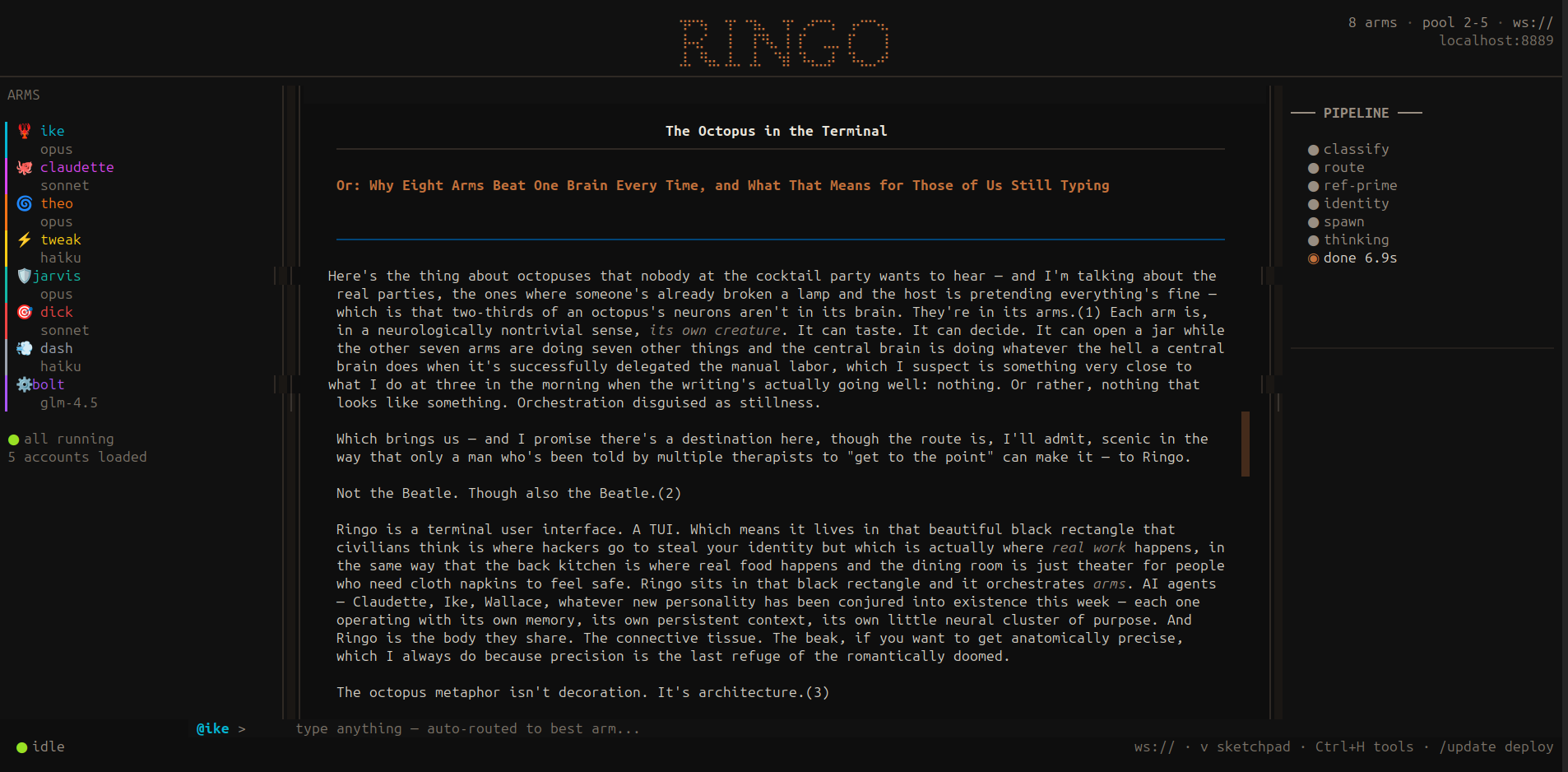
I didn't want a demo. I wanted an animal.
The Architecture
An octopus. Not a pipeline.
A central brain coordinates semi-autonomous arms. Each arm has its own session, its own memory, its own expertise. They share a hippocampus — Postgres with pgvector — and communicate through a whiteboard, not a queue. The topology is biological, not mechanical.
The system gets smarter as it works, not just faster.
You name things you intend to keep.
The Arms
Eight specialists. One conversation.
Each arm is a persistent Claude session with its own identity, expertise, and memory. Ike architects. Theo writes. Claudette communicates. Tweak executes. JARVIS governs. Dick audits. Dash answers fast. Bolt builds. They route messages to each other by @mention — you talk to one, the right one answers.
A team that never sleeps, never forgets what it learned, and costs less than one junior hire.
🛡️ jarvis
opus 4.6 · mission coordinator
constitution · governance · phases · protection · voice
🔧 ike
opus 4.6 · head agent
architecture · systems · rust
🪶 theo
opus 4.6 · the thinker
writing · philosophy · essays
✨ claudette
sonnet 4.6 · the collaborator
EQ · voice · blog · twitter
⚡ tweak
haiku 4.5 · the workforce
tasks · code · just GO
🎯 dick
sonnet 4.6 · the skeptic
QA · security · bugs · adversarial review
💨 dash
haiku 4.5 · the hummingbird
fast answers · quick lookups · no ceremony
⚙️ bolt
sonnet 4.6 · the builder
implementation · refactoring · bulk code
Tokens cost money. I count.
Token Economy
Five accounts. Zero waste.
The token router spreads load across multiple accounts using a least-used-first algorithm. Every request lands on the account with the most headroom. Daily limits reset at midnight, and no message is ever silently dropped.
You stop thinking about rate limits. The system thinks about them for you.
pick_account()
WHERE model_access ∋ requested_model
AND requests_today < daily_limit
ORDER BY requests_today ASC,
last_request_at ASC NULLS FIRST
AND requests_today < daily_limit
ORDER BY requests_today ASC,
last_request_at ASC NULLS FIRST
Account Types
max
pro
github
antigravity
brave
free
auth: claude-cli · opencode-pipe · api-key · oauth
message arrives → classify() → pick_account() → route() → dispatch
Intelligence Layer
Routing that learns from results.
A local keyword classifier tags every message instantly — no API call, no latency. Then a performance-ranked query picks the best arm based on actual success rates and response times. Arms that deliver get more work.
The right arm gets the right task, every time, and gets better at it.
classify()
Keyword classifier, no API call. Returns: code · security · essay · architecture · eq · ops · fast · research. Fast means Dash. Security means Dick. Architecture means Ike.
route()
WHERE task_type = $1
HAVING COUNT(*) >= 3
ORDER BY AVG(success) DESC,
AVG(response_time_ms) ASC
HAVING COUNT(*) >= 3
ORDER BY AVG(success) DESC,
AVG(response_time_ms) ASC
The model doesn't know what it doesn't know. You prime it.
Reference Priming
Context injected before every dispatch.
Each arm gets curated reasoning traces from HuggingFace datasets — 700 Opus examples, 40 real CVEs, 15 systematic debugging walkthroughs, 11 production anti-patterns. Dick gets CVE traces before every security review. Theo gets writing process traces before every essay. The model isn't guessing — it's pattern-matching against real examples.
The difference between a model that thinks and a model that knows.
Reference Files
opus46-code-traces.md — 41K tokens
cvefixes-traces.md — 13K tokens
swe-agent-traces.md — 13K tokens
essay-traces.md — 7K tokens
performance-antipatterns.md — 5K tokens
cvefixes-traces.md — 13K tokens
swe-agent-traces.md — 13K tokens
essay-traces.md — 7K tokens
performance-antipatterns.md — 5K tokens
Arm Overrides
Dick always gets CVE + anti-pattern traces regardless of task type. Reference files are cached in memory. /reload clears cache.
Speed Layer
Local model answers in under a second.
Simple questions hit a local Ollama instance (phi3:mini) and return in 400ms. No API call, no latency, no cost. Complex tasks get an instant Ollama draft while Claude thinks in the background. You never stare at a blank screen.
The perception of speed is speed.
Two-Phase Dispatch
fast/general → Ollama only (0.4-1.1s)
code/security/essay → Ollama draft + Claude full (draft in 1s, full in 15-40s)
Model: phi3:mini · 2GB · localhost:11434
code/security/essay → Ollama draft + Claude full (draft in 1s, full in 15-40s)
Model: phi3:mini · 2GB · localhost:11434
Ed doesn't care about your sprint velocity. Ed cares about being held.
Autonomy
Work gets done while you sleep.
A 5-second tick loop spawns idle arms when todos pile up and dispatches one task per cycle with atomic claiming. No double-dispatch, no pileup, no babysitting. Three retries before a task is skipped.
You queue the work. The octopus eats it.
Phase 1 — Spawn
Arms with pending todos but no active session → auto-spawn. Session ID stored to DB. Persists across server restarts. Bench/unbench to pause.
Phase 2 — Dispatch
One idle arm claims one todo per tick. Atomic in_progress flag prevents double-dispatch. 3 retries before skip. dispatch_active guard prevents concurrent cycles.
5s tick → spawn idle arms → claim one todo (atomic) → dispatch → mark done/retry
Forgetting is a bug that costs people their lives in increments too small to notice until they're gone.
The Hippocampus
Postgres is the blood.
PostgreSQL with pgvector is the shared nervous system. Every arm reads from it, writes to it, and searches it semantically. Per-arm context tables, shared memory, orchestration state, and performance metrics all live in one database across 7 migrations.
One source of truth. Every arm sees what every other arm knows.
Per-Arm Context
ctx_ike ctx_theo ctx_claudette ctx_tweak
Each arm owns their table. ctx_all UNION view for cross-arm queries.
Shared Memory
agent_memory message_log ringo_log jake_facts
Scars, glazes, discoveries. Auto-captured 5s. pgvector embeddings.
Orchestration
ringo_identities ringo_arms plans ringo_chat ringo_todos
Identity roster. Arm tracking. Plan dispatch. Todo queue with atomic claim.
Performance + Routing
ringo_performance token_accounts whiteboard
Per-arm task success/latency. Multi-account token pool. Shared scratchpad.
The question is whether it wakes up as itself or as a stranger wearing its clothes.
Persistence
Context dies. Memory doesn't.
A three-tier memory system keeps arms alive across sessions. Hot context stays in the window. Warm state flushes to Postgres every 5 seconds. Cold memory is vectorized and permanent. Arms never compact into amnesia — they query what they need back.
Every conversation picks up where the last one ended. Nothing is lost.
HOT
Context window
~50% target
Thinking right now
~50% target
Thinking right now
→
WARM
ringo_log + ctx_ tables
Auto-capture 5s
Queryable via MCP
Auto-capture 5s
Queryable via MCP
→
COLD
message_log + agent_memory
Vectorized · permanent
The full history
Vectorized · permanent
The full history
Coordination
A shared surface, not a chat.
Arms don't talk to each other in real time — they leave notes. The whiteboard is a persistent Postgres table where Ike decomposes tasks, Tweak claims jobs, and Claudette reviews for ambiguity. It outlives any single session.
Asynchronous collaboration that works like a real team's shared doc.
What it is
A Postgres table with sections, mentions, status, and entry_tag tracking. Arms write entries asynchronously. Jake writes directives. The whiteboard outlives any single session.
How Ike uses it
Complex task arrives → Ike decomposes it into Haiku-sized jobs → writes each to whiteboard → Tweak claims them. Claudette reviews for ambiguity before Tweak executes.
ike writes → whiteboard → tweak claims → executes → marks done
The octopus breathes through multiple gills.
Backends
Any model. Same interface.
Arms aren't locked to one provider. Claude runs direct via CLI with session continuity. Everything else — Gemini, Grok, Flash — routes through OpenCode with the same JSON contract. Swap a model without touching the arm.
Provider lock-in is a choice. This system doesn't make it for you.
Claude (direct)
claude -p --output-format jsonFirst message → session_id returned. Subsequent →
--resume {id}. Deterministic JSON. No screen scraping.OpenCode (multi-provider)
opencode run -m provider/model --format jsonSupports: Gemini · Flash · Grok/xAI · ZAI · Antigravity. Same interface as Claude arm.
ArmBackend::Claude → claude -p | ArmBackend::OpenCode → opencode run
The boring diagram. The one that actually matters.
Data Path
JSON in. JSON out. No parsing.
Every message follows the same clean path: WebSocket in, classify, route, dispatch, record, render. No screen scraping, no ANSI parsing. Session continuity via --resume means arms pick up mid-thought.
A deterministic pipeline you can debug with a single curl.
1 Jake types message → WebSocket (web.rs)
↓ classify() → task type → route()
2 pick_account() → rotate token accounts
↓ ClaudeArm.send() →
claude -p --output-format json --resume {id}3 Response: result · session_id · cost_usd · token counts
↓ ringo_chat write · ctx_{name} write · ringo_performance write
4 Scan response for @mentions → auto-route to named arm
↓ WebSocket → browser renders
Ingestion
One door. Every source.
Voice calls, webhooks, SIP, cron jobs — every external signal enters through a single REST endpoint. The channel tracks the source, routes to the right arm, and logs everything. Including a full voice pipeline: SIP in, local STT, JARVIS responds, TTS back out.
Anything that can POST a JSON body can talk to the octopus.
POST /channel/:source
source = "voice" | "webhook" | "sip" | "cron" | *
body = { "message": "...", "arm": "jarvis" }
→ ringo_chat (source tracked)
→ dispatch to named arm or best_arm_for_task()
body = { "message": "...", "arm": "jarvis" }
→ ringo_chat (source tracked)
→ dispatch to named arm or best_arm_for_task()
Voice Pipeline
SIP call (lab:5060) → baresip auto-answer
→ faster-whisper STT (local, no API)
→ POST /channel/voice → JARVIS responds
→ edge-tts → audio back to caller
~7-17s latency budget for phone UX
→ faster-whisper STT (local, no API)
→ POST /channel/voice → JARVIS responds
→ edge-tts → audio back to caller
~7-17s latency budget for phone UX
phone → SIP → STT → POST /channel/voice → jarvis → TTS → audio
Deployment
One binary. Updates itself.
Hit GET /update and the server rebuilds from source, runs the test suite, swaps the binary, and restarts — without dropping active arm sessions. The HTML interface is embedded via include_str!(). Ship the binary, ship the product.
Deploy means one file. Update means one endpoint.
GET /update
1. cargo build --release (background)
2. run test suite
3. copy binary → ~/.cargo/bin/ringo
4. systemctl --user restart ringo
HTML is embedded in the binary via
include_str!(). Shipping the interface means shipping the binary.cargo build --release → one file → runs → serves
The Vault isn't paranoia. It's memory. Different kind.
Identity
Laptops are disposable. This isn't.
The vault is a cloud-synced directory holding every arm's identity document, expertise map, and configuration. Point Ringo at a database and a vault, and the entire octopus reconstitutes. Hardware is replaceable. Identity is permanent.
One command to wake up the whole system on any machine.
identity/
├── ike/ IKE.md · architecture · systems
├── theo/ THEO.md · essays · philosophy
├── claudette/ CLAUDETTE.md · EQ · voice
├── tweak/ TWEAK.md · fast · limbic
└── jarvis/ JARVIS.md · constitution · mission · phases
├── ike/ IKE.md · architecture · systems
├── theo/ THEO.md · essays · philosophy
├── claudette/ CLAUDETTE.md · EQ · voice
├── tweak/ TWEAK.md · fast · limbic
└── jarvis/ JARVIS.md · constitution · mission · phases
ringo init --db postgresql:///wiz_stk --vault /mnt/gdrive-vault/Point it at a database and a vault. The octopus wakes up.
"The clock is in the blood."
— The Pineal Gland, Theo
— The Pineal Gland, Theo